
In this article a journey of an idea of creating a Cross-pin with 4 rooks and a minor piece.
A long time ago I played Correspondence Chess.
In the game below I was Black and a Pawn down, but possibly it is a drawish position anyway.
But I wanted to regain the a2-pawn and played therefore 1... Bb2
I had to calculate if a Crosspin is dangerous or not.after 2.Rb1 Rxa2.
There were no chess engines in those days.
White did not play 2.Rb1!? but as can be seen, Black can easily get out of the pin.
That idea of a Cross pin on a minor-piece by two rooks,
where the struggle is to get the piece into or out of the pin or not?
I had not seen this theme / task in any study so far.
I was looking for positions or studies like these:
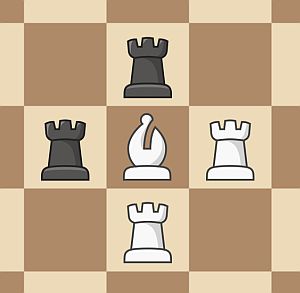
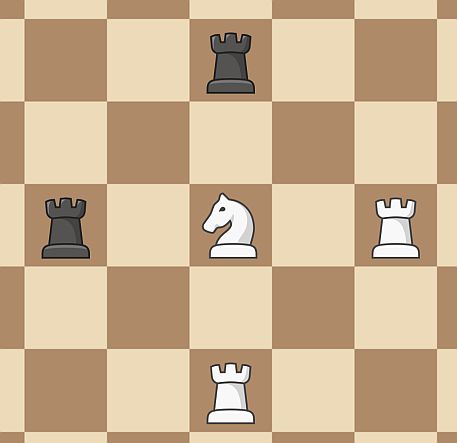
(Of course the task can be extended by other double cross pins i.e. where Queens are involved).
I asked Gady Costeff (Costeff, Gady 1961 ) for a CQL to find examples in the latest hhdbvii database.
Using this CQL gave two examples, but only one is with a minor piece.
cql (input heijden.pgn )
hhdb sound
piece T in [Aa]
{R attacks T == 2
r attacks T == 2}
So the theme / task is seldom used!
The first study is not realy a cross-pin with a minor piece.
The second study by the great composer Rinck, Henri 1870-1952 is the only study so far with this task.
In the Argentinian magazine by Copie, José 1941 : Finales Y Temas 126 (at page 2488)
I presented this task to composers, but there was no reaction.
I started composing myself and came up with the position below
It is a very explosive position.
Black threatens mate by Rh4+ and Rc1+
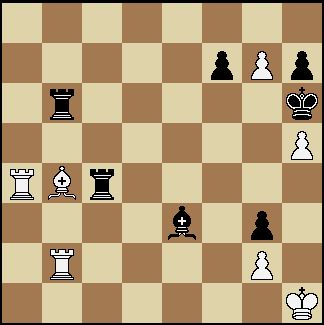
After White first and only move to prevent all this 1. Bd2! ,
4 Rooks are en prise but also the two Bishops are vulnerable.
In the end it looks as if White is winning but Black has Stalemate tricks or goes for the Positional draw!
Because it ends in a draw may be we should convert colours?
(and as example a little change of the scene is done):
I showed this position and other tries to many strong study composers.
Out of all that some Co-creations of studies were created, but none with a Cross-pin as intended.
Finally with Osintsev, Sergei 1960 I had more succes with another type of position with a double cross-pin.
I showed him another example and he came back with this:
Finally we created a better version which was awarded 6th prize in the Gatti 10th AT tournament.
I created also White knight jumps into the Cross-pin.
I hope its correct?
Another try with a crazy position.
The White Bishop jumps out of the pin twice and in once, also the Black Knight jumps in as well.
Another try first White is unpinning and then Black puts its bishop in the pin, simple but funny.
Crazy position, starting to bring the bishop in the Cross-pin
and a funny only refutation at the first move by Black to keep the draw:
I hope these examples show what kind of processes are going on by trying to find and create endgame studies with a certain task.
I hope this inspires composers to create endgame studies with double cross-pin positions.
Peter Boll.